Cleanthes: The Student They Called "the Donkey"
An English Story for Learners With a Video and a Quiz
Cleanthes was a Greek philosopher (a person who thinks about life) who lived in ancient Athens around 300 BC.
This page tells his story in easy English for learners, with a video, new words, and a quiz.
Watch the video first. Then read the story, learn the new words, and take the quiz.
Your classmates call you "the donkey." They don't know it yet, but one day, you will be their teacher.
You are Cleanthes, a young boxer from a small town by the sea.
One day you stop fighting, and you travel to Athens, because you want to learn. You have only four small coins in your hand.
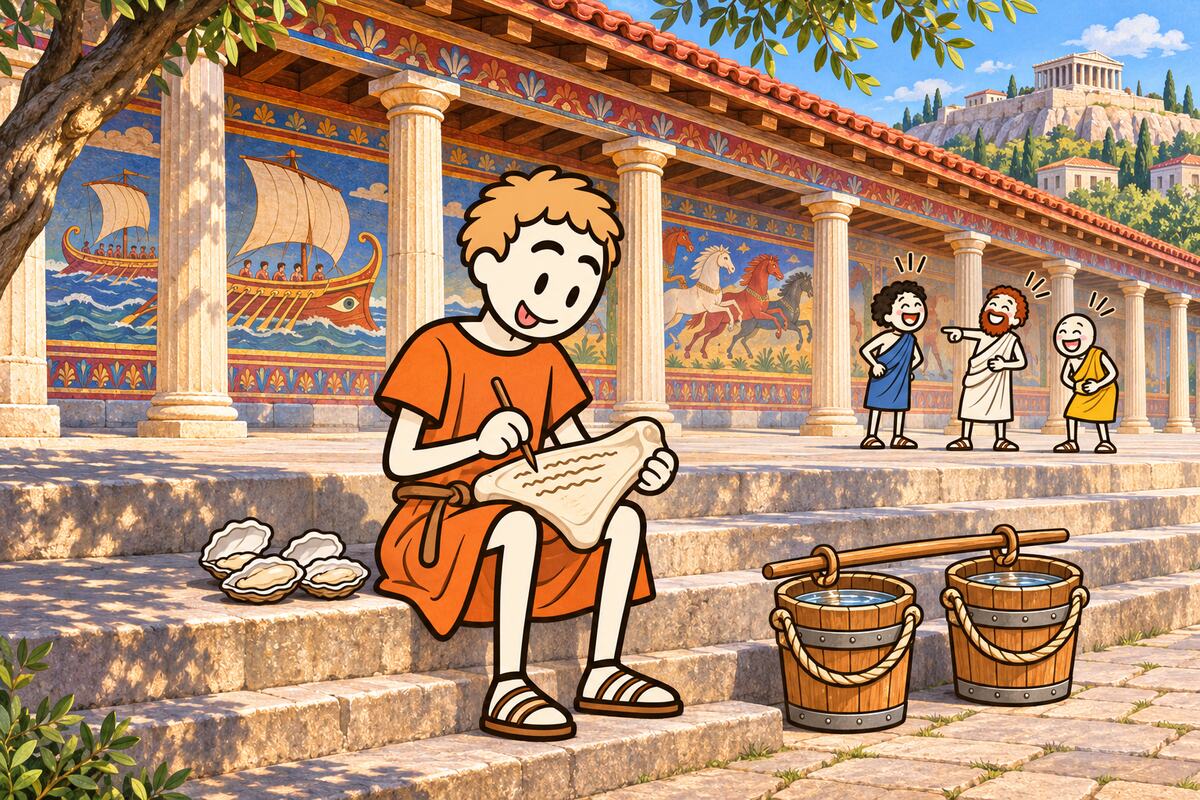
In Athens, you find a great teacher. He teaches outside, under a painted porch.
But you have to eat, and four coins don't last long. So you find a job. A very strange job.
Every night, while Athens sleeps, you carry water from a well for a gardener. Bucket after bucket, until the morning.
Then you run to class, tired but happy.
But people in Athens start to talk. This man is big and strong, but nobody sees him work. Where does his money come from?
So they take you to court. The judges look at you. And you bring in, a gardener.
The gardener says, it's true, he carries my water every night! The judges are so surprised that they want to give you money.
But in class, things are not easy. You learn slowly. Very slowly. The other students are faster, and they laugh at you.
You just smile and say, yes, I'm a donkey. And only a donkey is strong enough to carry all of our teacher's ideas.
You have no money for paper. So you write your lessons on seashells, and on old ox bones!
Your teacher says you are like a hard writing board. It's hard to write on, but the words stay there forever.
One year passes. Then five. Then ten. You stay with your teacher for nineteen years.
Then your old teacher dies, and the school needs a new leader. There are many clever students. So who do they choose?
The donkey.
You lead the school for more than thirty years, and people still read your words today.
So, you learn English slowly? That's fine. Slow is okay. Just don't stop.
And please, write on paper. Not on bones.
classmates the other students in your class
From the story: Your classmates call you "the donkey."
a donkey an animal like a small horse with long ears; it can carry heavy things
From the story: Your classmates call you "the donkey ."
strange not usual; different from what you know
From the story: A very strange job.
a well a deep hole in the ground where people get water
From the story: Every night, while Athens sleeps, you carry water from a well for a gardener.
a gardener a person who takes care of a garden
From the story: Every night, while Athens sleeps, you carry water from a well for a gardener .
a bucket an open container with a handle, used to carry water
From the story: Bucket after bucket, until the morning.
court the place where judges decide if a person did something wrong
From the story: So they take you to court .
a judge a person who decides things in court
From the story: The judges are so surprised that they want to give you money.
clever quick to learn and understand
From the story: There are many clever students.
to choose to decide which person or thing you want
From the story: So who do they choose ?
Choose the right answer. You will see at once if you are right.
🔊 Sound on
1. What was Cleanthes before he came to Athens?
A) A gardener B) A boxer C) A judge
He was a young boxer from a small town by the sea.
2. How much money did he have in Athens?
A) Four small coins B) Forty silver coins C) One gold coin
He had only four small coins in his hand.
3. What was his job at night?
A) He sold bread at the market B) He wrote books for his teacher C) He carried water from a well
Every night he carried water from a well for a gardener.
4. Why did people take him to court?
A) Nobody saw him work B) He was rude to a judge C) He took some water
He was big and strong, but nobody saw him work. People asked: where does his money come from?
5. What did he write his lessons on?
A) On paper and wood B) On shells and bones C) On the walls of the school
He had no money for paper, so he wrote on seashells and on old ox bones.
6. What is the lesson of the story?
A) Fast learners always win in the end B) Never write on bones C) Slow is fine, just don't stop
Slow is okay. Just don't stop.
Talk About It
Do you learn slowly or fast? What helps you keep going when learning English feels slow?
Tell us in English in the comments under the video.
More stories in easy English