ESL Lesson Plans for Adults: 3 Free Ready-to-Teach Plans
These free ESL lesson plans for adults are ready to teach: three complete 60‑minute lessons on real‑life English, at the doctor's office, in a job interview and at the bank. Each plan has a goal, a warm‑up, vocabulary, a dialog, practice, a role‑play with a free game, a wrap‑up and homework. The dialogs use real lines from our Say It Right game, so the class can practice the same English on the screen.
- Plan 1: At the doctor's office (A2)
- Plan 2: First questions in a job interview (A2)
- Plan 3: At the bank: open an account (B1)
- Adapt the plans
Every plan follows the same steps, so after the first lesson your students know what comes next. Read the plan once, print the dialog for each pair, and you are ready.
Click Here for Step-by-Step Rules, Stories and Exercises to Practice All English Tenses
Lesson plan 1: At the doctor's office (A2)
| Level | A2, adults |
|---|---|
| Time | 60 minutes |
| Goal | Students can tell a doctor what is wrong, where it hurts and when it started, and answer the doctor's usual questions. |
| Key language | What brings you in today? I have a bad cough / a headache / a fever. It started three days ago. It hurts here. I'm allergic to ... |
| Materials | The board, this plan (one dialog per pair), a projector or one phone per pair for the game. |
5 min Step 1: Warm‑up
Draw a simple person on the board. Students call out body parts, and you write them: head, throat, chest, stomach, back. Then ask: "When did you last see a doctor? Was it easy to explain the problem?" Students can answer about a friend.
10 min Step 2: Vocabulary
- What brings you in today? The doctor asks why you came.
- I have a bad cough / a headache / a fever. Say what is wrong.
- It started three days ago. Say when the problem started.
- It hurts here. Show the place that hurts.
- I'm allergic to ... Something makes you sick, like a food or a medicine.
- About a six out of ten. Say how bad the pain is.
Say each phrase, and the class repeats. Then mime a problem (hold your head), and the class says the phrase: "I have a headache."
10 min Step 3: Dialog
Dr. Lee: Hi there. What brings you in today?
Patient: I have a bad headache. It started three days ago.
Dr. Lee: I see. Where does it hurt?
Patient: Here, on the right side of my head.
Dr. Lee: Do you have a fever?
Patient: Yes, a small one. I felt hot last night.
Dr. Lee: Are you taking any medicine?
Patient: Yes. I take one pill for my blood pressure every day.
Dr. Lee: Are you allergic to anything?
Patient: Yes, I'm allergic to nuts.
Read the dialog with a strong student. Then pairs read it two times and switch roles. The third time, the patient changes the problem: a cough, a sore back.
10 min Step 4: Practice: match the question to the best answer
- Does bright light make it worse? Answer: Yes. Bright light hurts my eyes.
- Are you sleeping OK? Answer: Not really. I wake up at night because of the pain.
- Do you drink coffee? Answer: Yes, two cups every morning.
- Where does it hurt? Answer: Here, on the right side of my head.
Write the questions and the answers on the board in a mixed order, and pairs match them. Then they ask and answer.
15 min Step 5: Role‑play with Say It Right
Open Doctor, level 1: "Say what's wrong" on the projector (Practice mode). Dr. Lee says a line, and the game shows 3 replies. Read the replies aloud. Pairs agree on the best one, and one student says it before you tap. After each answer, the game plays the best reply and shows a short tip: read the tip together. Each game picks 5 of the level's 8 lines, so a second round brings new lines.
Then pairs act out the situation without the screen. Give each student a card:
Patient: You have a sore back. It started two days ago, after you moved a sofa. It hurts when you sit. You don't take any medicine. You are allergic to penicillin.
Doctor: Ask: What brings you in today? When did it start? Where does it hurt? Are you taking any medicine? Are you allergic to anything?
7 min Step 6: Wrap‑up
Exit ticket: each student writes three sentences on a small paper: the problem, when it started, and one medicine or allergy (real or invented). Collect them at the door.
3 min Step 7: Homework
Play Doctor level 2, "Understand the plan", at home. Write down two new phrases and bring them to the next class. Open level 2 or read the useful phrases for this situation.
This lesson teaches English words and phrases. It is not health advice.
Lesson plan 2: First questions in a job interview (A2)
| Level | A2, adults |
|---|---|
| Time | 60 minutes |
| Goal | Students can greet an interviewer, talk about their work in one or two sentences, say why they want the job and ask one good question at the end. |
| Key language | Thank you for having me. I've worked in ... for five years. I want to grow with your team. What does a normal day look like here? I hope to hear from you soon. |
| Materials | The board, this plan (one dialog per pair), a projector or one phone per pair for the game. |
5 min Step 1: Warm‑up
Pairs ask each other: "What was your first job?" and "What is harder in an interview: the first minute or the last question?" Take two or three answers from the class.
10 min Step 2: Vocabulary
- Thank you for having me. A polite thing to say when an interview starts.
- I've worked in ... for five years. Say what work you do and how long you have done it.
- What does a normal day look like here? A good question to ask at the end.
- I hope to hear from you soon. A friendly way to finish the interview.
- interview A meeting where a company asks you questions before it gives you a job.
- hiring manager The person who chooses who gets the job.
Make two columns on the board: "Too casual" and "Good for an interview". Read these two replies to "Nice to meet you" and ask where each one goes: "Hey there! Yeah, that's me. Wow, this place is super cool, I love it!" and "Nice to meet you too. Thank you for having me."
10 min Step 3: Dialog
Ms. Brown: Hi, you must be here for the interview. Nice to meet you.
Candidate: Nice to meet you too. Thank you for having me.
Ms. Brown: Did you find the office OK?
Candidate: Yes, thank you. It was easy to find.
Ms. Brown: So, can you tell me a little about yourself?
Candidate: Sure. I'm a cook, and I've worked in restaurants for five years.
Ms. Brown: Why do you want this job?
Candidate: I love your food, and I want to grow with your team.
Ms. Brown: Do you have any questions for me?
Candidate: Yes. What does a normal day look like here?
Ms. Brown: Good question. We start at ten, and we plan the menu together. Thank you for coming in today.
Read the dialog with a strong student. Pairs read it two times and switch roles. The third time, the candidate talks about their own job.
10 min Step 4: Practice: make it about you
- I'm a ___, and I've worked in ___ for ___ years. Your job and your experience.
- I want this job because ___. One reason about the job or the company.
- One of my strengths is ___. One thing you are good at.
- At the end, I can ask: ___? A good question about the job.
Students complete the four lines about themselves. Walk around and help. Then they say their lines to a partner without looking at the paper.
15 min Step 5: Role‑play with Say It Right
Open Job interview, level 1: "First questions" on the projector (Practice mode, or the Live interview for a strong group). Ms. Brown says a line, and the game shows 3 replies. Read the replies aloud. Pairs agree on the best one, and one student says it before you tap. After each answer, the game plays the best reply and shows a short tip: read the tip together. Each game picks 5 of the level's 8 lines, so a second round brings new lines.
Then pairs act out the situation without the screen. Give each student a card:
Interviewer: Ask: Did you find the office OK? Can you tell me a little about yourself? Why do you want this job? Are you OK working on busy days? Do you have any questions for me?
Candidate: Use your own job, or this one: you are a cook with five years in restaurants. You want to work in a busy hotel kitchen.
7 min Step 6: Wrap‑up
Each student says their "tell me about yourself" answer to the class in 20 seconds. The class gives one tip: one thing that was good.
3 min Step 7: Homework
Play Job interview level 2, "Strengths and weaknesses", at home. Write your own answer to "What are your biggest strengths?" Open level 2 or read the useful phrases for this situation.
This lesson teaches English for interviews. It is not career advice.
Lesson plan 3: At the bank: open an account (B1)
| Level | B1, adults |
|---|---|
| Time | 60 minutes |
| Goal | Students can open a checking account: say what they want, give an ID and proof of address, and ask about fees, ATMs and interest. |
| Key language | I'd like to open a checking account. Here's my photo ID and proof of address. Is there a monthly fee? What's the interest rate? Can I use it on my phone? |
| Materials | The board, this plan (one dialog per pair), a projector or one phone per pair for the game. |
5 min Step 1: Warm‑up
Ask the class: "How do you usually pay: cash, a card or your phone?" Then: "What is the difference between a checking account and a savings account?" Write the best answers on the board.
10 min Step 2: Vocabulary
- I'd like to open a checking account. An account for everyday money.
- Is there a monthly fee? Ask if you pay money for the account.
- Here's my photo ID and proof of address. Papers that show who you are and where you live.
- I'd like to deposit some money. Put money into your account.
- I'd like to make a withdrawal. Take money out of your account.
- interest Money the bank pays you to keep your money there.
Write the key words on the board: checking, savings, deposit, withdraw, fee, debit card, ATM, interest, PIN. Pairs explain each word to each other in their own words.
10 min Step 3: Dialog
Omar: Good morning. What can I do for you?
Customer: I'd like to open a checking account, please.
Omar: Great. I'll need a photo ID and proof of address.
Customer: Here's my passport, and this is a bill with my address on it.
Omar: Would you like a debit card with the account?
Customer: Yes, please. Is there a monthly fee for the card?
Omar: It's ten dollars a month, but it's free if you keep fifteen hundred in the account.
Customer: I see. And are there any fees for using other banks' ATMs?
Omar: Yes, it's two fifty each time. Our own ATMs are free. Would you also like a savings account?
Customer: Maybe. What's the interest rate on it?
Omar: It's one percent a year. Last thing: please choose a four‑digit PIN for your debit card.
Customer: OK. Should I type it in here, on this keypad?
Omar: Yes, right there. And please don't say it out loud.
Read the dialog with a strong student. Pairs read it two times and switch roles. Ask: "Why does the customer ask about fees before saying yes?"
10 min Step 4: Practice: ask about it
- There is a monthly fee. Answer: Is there a monthly fee?
- You can use the app on your phone. Answer: Can I use the app on my phone?
- The savings account pays interest. Answer: What's the interest rate on the savings account?
- Other banks' ATMs cost money. Answer: Are there any fees for using other banks' ATMs?
Read each sentence. Pairs turn it into a question a customer can ask. Then check the answers together.
15 min Step 5: Role‑play with Say It Right
Open Bank, level 2: "Open an account" on the projector (Practice mode). Omar says a line, and the game shows 3 replies. Read the replies aloud. Pairs agree on the best one, and one student says it before you tap. After each answer, the game plays the best reply and shows a short tip: read the tip together. Each game picks 5 of the level's 8 lines, so a second round brings new lines.
Then pairs act out the situation without the screen. Give each student a card:
Bank teller: Ask for a photo ID and proof of address. The checking account is ten dollars a month, but free if the customer keeps fifteen hundred dollars in it. Ask the customer to choose a PIN.
Customer: You want a checking account and a debit card. Ask about the monthly fee, ATM fees and online banking. Never say your PIN out loud.
7 min Step 6: Wrap‑up
Exit ticket: each student writes two questions they will ask before they open a bank account.
3 min Step 7: Homework
Play Bank level 3, "Solve a money problem", at home. Write down what you would say if you saw a charge you don't recognize. Open level 3 or read the useful phrases for this situation.
This lesson teaches English words and phrases. It is not money advice.
How to adapt these lesson plans
- For beginners: use only the dialog and the game. Read the dialog many times, and let students keep the paper during the role‑play.
- For stronger groups: almost every situation in Say It Right has three levels, from A2 to B2. Use level 2 or 3 for the role‑play step.
- For one‑to‑one and online lessons: share your screen for the game, and you take the other role in the pair work.
- For more topics: Say It Right has 32 real‑life situations, like the pharmacy, a landlord and the post office. The same seven steps work for each one.
For speaking practice before or after these lessons, use our ESL conversation questions for adults. For idioms, print the idioms worksheet with pictures and answers. To plan your own lessons, read what makes the best English lesson plans, teaching English to adults and our daily lesson plan template.
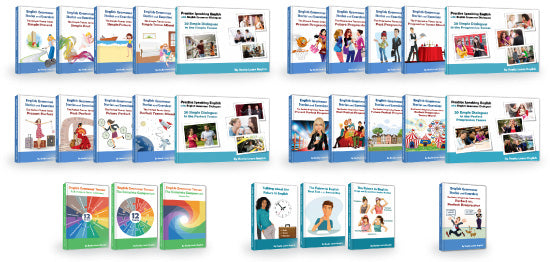
Need more ready‑to‑print material? Our English teacher resource kit has all our eBooks and worksheets in one package: 75 books, workbooks and booklets, and 66 worksheets, with answer keys. You can show the pages in class and print them for your students.
Questions about ESL lesson plans for adults
What should an ESL lesson plan for adults include?
A clear goal, a short warm-up, the key vocabulary, a model such as a dialog, controlled practice, a freer speaking task like a role-play, a wrap-up and homework. Adults also need a topic from real life, like work, health or money.
How do you plan a 60‑minute ESL class for adults?
A simple plan is 5 minutes of warm-up, 10 of vocabulary, 10 for a dialog, 10 of practice, 15 of role-play and 10 to wrap up and set homework. Each plan on this page follows these times.
Are these ESL lesson plans free? Can I get them as a PDF?
Yes, they are free. Click the print button above a plan and choose "Save as PDF" in the print window. Each plan prints on its own.
What level are these lesson plans?
The doctor and job interview plans are for A2, and the bank plan is for B1. You can make each one easier or harder with the three levels of the role-play game.
How do I make ESL lessons for adults not childish?
Use adult situations, like a job interview or the bank, and real sentences that people say. Keep the language simple, but never talk to adults like children.
Do I need a projector for these lesson plans?
No. A projector helps for the role-play game, but students can also play on their phones in pairs. The rest of each plan needs only a board and the printed dialog.
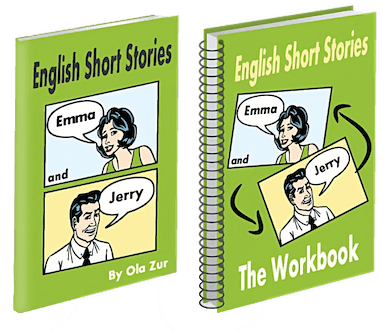
Want new free worksheets and lesson ideas by email? Join our list in the box at the bottom of this page. When you join, you get a free gift: the first two chapters of our English Short Stories book and workbook.
Get Updates, Special Offers, and English Resources
Download your FREE GIFT (the first two chapters of
English Short Stories Book and Workbook)
as soon as you join!
By submitting your email, you consent to receiving updates and newsletters from us and to the sharing of your personal data with third parties for the purposes of sending you communications. We will not spam you. You can unsubscribe at any time. For more information, please see our privacy policy.
Return
from ESL Lesson Plans for Adults
to ESL eBooks and Teaching Materials
Return from
ESL Lesson Plans for Adults
to Really Learn
English Home