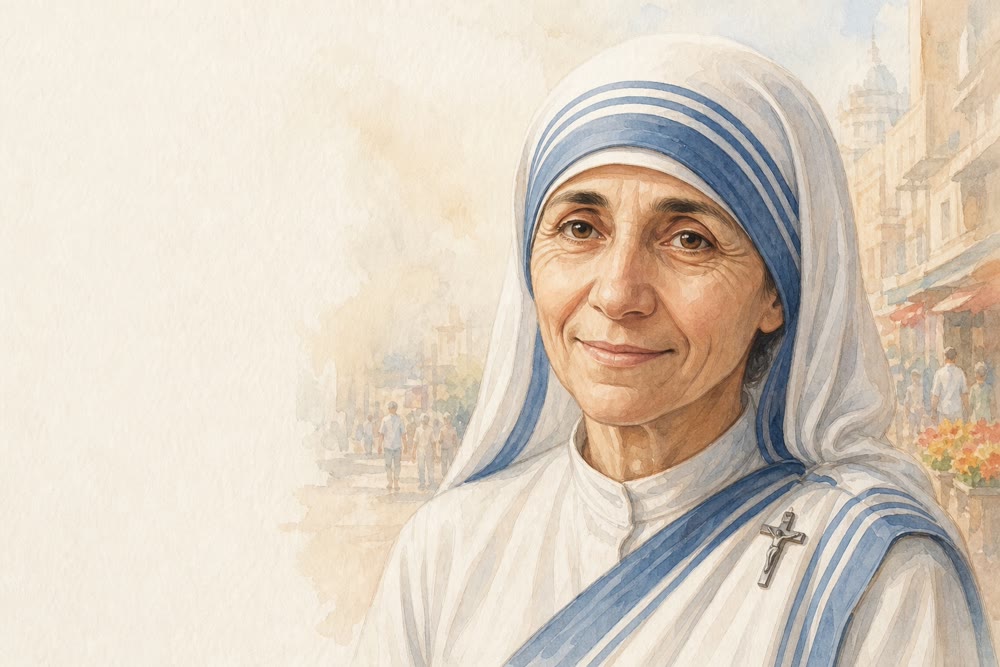
Learn English with the true story of Mother Teresa, the small woman in a white sari who helped the poorest people in Calcutta.
Watch the video, take the short quiz, learn the new words, and print the free worksheet.
English level: A2 (Level 2).
How did a quiet girl from a small city become one of the most famous women in the world?
Her name was Agnes. She left her home at eighteen, became a teacher in India, and then gave her whole life to the poor. Today the world knows her as Mother Teresa, or Saint Teresa of Calcutta.
The story uses simple words and short sentences, so it is easy to follow.
This is the story of a small woman in a white sari.
She had no money. She had no house. She owned almost nothing.
But she changed the lives of millions of people around the world.
Her name was Mother Teresa.
How did a quiet girl from a small city become one of the most famous women in the world? Listen to her story, learn new English words, and practice your listening.
Relax, and let's begin.
Part 1: A Girl Named Agnes
Our story begins on August 26, 1910, in a city called Skopje. Today, Skopje is the capital of North Macedonia, a small country in southeastern Europe. But in 1910, the city was part of a big empire, the Ottoman Empire. Agnes's family was Albanian.
On that day, a baby girl was born. Her parents named her Agnes. Her full name was Agnes Gonxha Bojaxhiu. "Gonxha" means "little flower" in the Albanian language.
Agnes was the youngest child in her family. She had an older sister and an older brother. Her father, Nikollë, was a businessman. Her mother, Drana, took care of the home and the children.
Agnes's mother was a devout Catholic. "Devout" means that she believed very strongly in God and in the Church. She went to church often, and she taught her children to pray.
She also taught them something very important: to help other people.
When Agnes was eight years old, her father died. It was a very hard time for the family. They did not have much money anymore. But her mother did not give up. She started a small business, sewing and selling cloth, so she could take care of her children.
And even when the family had very little, her mother always shared. Poor people often came to their home, and she gave them food. Sometimes she invited them to eat at the family table.
She told Agnes, "My child, never eat a single bite unless you are sharing it with others."
Agnes never forgot these words.
Part 2: A Long Journey
When Agnes was twelve years old, she felt a "call" to religious life. This means that she felt, deep in her heart, that she wanted to give her life to God.
She wanted to become a nun. A nun is a woman who lives her life for God and the Church. Nuns do not marry, and they often work to help other people.
Agnes also loved to read stories about missionaries. A missionary is a religious person who goes to another country to teach and to help people. Agnes read about missionaries in India, and she dreamed of going there one day.
When she was eighteen years old, she made a big decision. She left her home, her family, and her city. She traveled all the way to Ireland.
In Ireland, she joined a group of nuns called the Sisters of Loreto. She lived in a convent. A convent is a house where nuns live together.
Why Ireland? Because the Sisters of Loreto worked in India, and they taught in English. So Agnes had to learn English first.
Saying goodbye was not easy. Agnes said goodbye to her mother at the train station in 1928. She did not know it then, but she would never see her mother again.
Part 3: The Teacher in Calcutta
In 1929, Agnes arrived in India. She was nineteen years old. First, she lived in Darjeeling, a town in the mountains, where she studied to become a nun.
On May 24, 1931, she made her first promises as a nun. These promises are called "vows." On that day, she chose a new name: Teresa. She chose this name because of Saint Thérèse, a French nun she loved.
Then Sister Teresa moved to Calcutta, a very big and busy city in India. Today, the city is called Kolkata.
In Calcutta, she worked at a school for girls called Saint Mary's. She taught history and geography. Many of her students came from poor families.
Sister Teresa learned to speak the local languages, Bengali and Hindi. Her students loved her. She was kind, she was patient, and she had a warm smile.
On May 14, 1937, she made her final vows. Now she was a nun for her whole life. From then on, people called her Mother Teresa.
She worked at the school for almost twenty years. In 1944, she became the headmistress. A headmistress is the woman who leads a school.
Mother Teresa was happy at Saint Mary's. But outside the school walls, there was a very different world.
Part 4: The Call on the Train
Around the school, there were many slums. A slum is a very poor part of a city. In the slums of Calcutta, many families lived in small, simple houses, and many children could not go to school.
Every day, Mother Teresa saw these people from the school. And every day, she thought about them.
On September 10, 1946, Mother Teresa was traveling by train to Darjeeling, the town in the mountains where she studied. On the train, something changed her life.
She felt that God was speaking to her heart. She later called it "a call within a call." She felt that God was asking her to leave the school and to go and live with the poorest people in Calcutta, and to help them.
This was not an easy thing to do. She loved her school. She loved her students, and she loved her life with the other nuns.
But Mother Teresa was sure. This was what she had to do.
She asked for permission to leave. She waited for almost two years. Finally, in 1948, the answer came: yes.
Part 5: Into the Streets
In August 1948, Mother Teresa took off the clothes of the Loreto Sisters. Instead, she put on a simple white cotton sari with a blue border. A sari is a long piece of cloth that many women in India wear.
This white and blue sari later became famous all over the world.
First, she went to the city of Patna for a few months. There, she learned basic medical care from nurses at a hospital. She learned how to clean a wound, how to give medicine, and how to take care of sick people.
Then she came back to Calcutta, and she walked into the slums.
She had no money and no building. But she had an idea. She found a group of children in a slum called Motijhil, and she started a school for them, right there, outside.
There were no desks and no books. Mother Teresa used a stick to write letters on the ground. The children sat around her and learned to read and write.
At first, there were only five children. But soon, more and more children came every day.
Mother Teresa also visited families in their homes. She brought medicine, and she helped people who were sick. She smiled at them, she talked with them, and she listened to them.
She also became an Indian citizen. India was now her home.
And slowly, something wonderful began to happen. Some of her old students from Saint Mary's came to help her. Young women from the city wanted to join her too.
Mother Teresa was not alone anymore.
Part 6: The Missionaries of Charity
On October 7, 1950, Mother Teresa started a new group of nuns. She called it the Missionaries of Charity. "Charity" means giving help to people who need it.
At first, the group had only about twelve sisters. They all wore the same white and blue sari, and they all lived a very simple life, just like the people they helped.
The sisters made a special promise. They promised to give "free service to the poorest of the poor."
In 1952, Mother Teresa opened a home for people who were very sick and had no one to take care of them. She called it Nirmal Hriday, which means "Home of the Pure Heart." There, people got a clean bed, food, medicine, and most of all, love. Mother Teresa wanted every person to feel wanted and cared for.
In 1955, she opened a home for children who had no parents. Here, the children had food, clothes, and a safe place to sleep. Many of them later found new families.
Mother Teresa also helped people with leprosy. Leprosy is a disease that hurts the skin. In the past, many people were afraid of it, so people with leprosy often lived alone. Mother Teresa built a special village for them, called Shanti Nagar, the "Town of Peace." There, they could get medicine, live together, and work.
Soon, people from all over the world heard about Mother Teresa. They sent money and gifts to help her work. Many people came to Calcutta to volunteer. A volunteer is a person who works to help others without getting paid.
In 1965, the Missionaries of Charity opened their first home outside India, in Venezuela, in South America. After that, they opened homes in many other countries: in Africa, in Asia, in Europe, and in America.
Mother Teresa traveled all over the world. Wherever she went, she taught the same simple idea: we do not need to do great things. We can do small things with great love.
Part 7: A Prize for the Poor
Mother Teresa received many international awards. The most famous was the Nobel Peace Prize, in 1979. This is one of the most important prizes in the world.
She traveled to Norway to receive the prize. But she did not change her clothes. She wore her simple white and blue sari, the same as every day.
And she did not want anything for herself. She said that she accepted the prize for the poor people of the world.
Usually, there is a big, expensive dinner for the winner of the Nobel Peace Prize. But Mother Teresa asked them not to have the dinner. She asked them to give the money to the poor people in India instead.
The dinner would cost about 192,000 dollars. All of that money went to help the poor.
Part 8: Remembering Mother Teresa
Mother Teresa worked until she was very old. Even when she was tired, she continued to travel, to visit the sisters, and to meet people who needed help.
She died on September 5, 1997, in Calcutta. She was eighty-seven years old.
When she died, the Missionaries of Charity had more than four thousand sisters. They worked in 610 homes and centers in 123 countries around the world.
People all over the world remembered her kindness. In 2003, the Catholic Church named her "Blessed." This is an important step before a person can become a saint.
Then, on September 4, 2016, the Catholic Church named her a saint. Today, many people call her Saint Teresa of Calcutta.
Ending
Mother Teresa was a small woman with a very big heart. She started with nothing: just a white sari, a stick, and five children in a slum.
But she believed that every person is important. And she showed the world that small things, done with great love, can change many lives.
By submitting your email, you consent to receiving updates and newsletters from us and to the sharing of your personal data with third parties for the purposes of sending you communications. We will not spam you. You can unsubscribe at any time. For more information, please see our privacy policy.