Easy English Grammar
English grammar can be easy! Read this for simple and easy English grammar explanations and exercises.

Click Here for Step-by-Step Rules, Stories and Exercises to Practice All English Tenses

What does GRAMMAR mean?
Grammar is simply the way we combine words together so that other people can understand us.For example, if I want to say this:

What happens if I say: "She is bottling a drink of water"?
The listener can understand that she is doing this action:

This is why grammar is important.
So as time went by, people made rules about how to use the words together. They made rules about how these words change to show different things. For example, "is drinking" shows the action happens now, and "drank" shows that the action happened in the past.
All these rules are important because they help us communicate our ideas and understand the ideas of other people.
But, if you don't know these rules, then grammar can seem quite complicated.
This is why we are here!
First of all, an excellent book on the subject: Grammar and Communication for children/English learnersNow, in this section you will find many English grammar exercises and simple English grammar explanations.
Furthermore, you can get this free English grammar test for download.
Online English grammar lessons
English
Verb Tenses
Simple tenses, progressive (continuous) tenses, perfect tenses,
perfect progressive (continuous) tenses.
Examples
of English Tenses
Example sentences.
Active
and Passive Voice
Active: "The ball hit Janet."
Passive: "Janet was hit" / "Janet was hit by the ball."
English
Grammar Articles (a, an, the)
"I need a
chair."
"I want an
apple."
"I want the red
apple."
English
Conditionals: First Conditional, Second Conditional, Third
Conditional and Zero Conditional
"If he catches a fish, he will be very happy."
"If I met a genie, I would ask for infinite wealth..."
"If I had any money, I would give you some."
"If I had paid more attention, I wouldn't have hit myself..."
"If the sun sets, it becomes night."
English
Moods: Indicative Mood, Imperative Mood and Subjunctive Mood
"We finished the project on time."
"Get plenty of rest!"
"I wish I had some cheese..."
"Clean your room, boys."
"Angela, answer the phone, please."
"Don't forget to call me after work."
"Let's not watch television tonight."
Subject-Verb Agreement
Correct: "Bob, not his wife, is doing the cooking."
Incorrect: "Bob, not his wife, are doing the cooking."
Asking Questions in English
Direct questions, indirect questions, yes/no questions, WH questions, alternative questions, tag questions.
Tag questions
"You like kittens, don't you?"
"Brenda is sad, isn't she?"
Direct Speech and Reported Speech (Indirect Speech)
"I am sorry." => "He said he was sorry."
Capitalization Rules in English
Which words should you capitalize and when, and how do you capitalize titles?
English parts of speech
English verbs
English Parts of Speech OverviewNouns, pronouns, adjectives, verbs, adverbs, prepositions, conjunctions and interjections.
Learn English Verbs
Examples: sing, drive, write, love, know, have.
Regular Verbs and Irregular Verbs
Regular: open, opened, opened
Irregular: take, took, taken
Main Verbs, Auxiliary Verbs (Helping Verbs) and Compound Verbs
be + eat => We are eating
Stative Verbs and Dynamic Verbs (Action Verbs)
Stative verbs: be, seem, love, own, want, sound, have, know, understand.
Dynamic (active) verbs: jump, catch, write, call, sleep, hit, open, speak.
Dynamic Verbs and Stative Verbs – Further Examples and Exercises
English Transitive Verbs and Intransitive Verbs
Transitive: "She is drinking a glass of water."
Intransitive: "She is standing."
English Linking Verbs
"I am a singer."
"He became angry."
"Amy turned red."
English Phrasal Verbs
Run into, make up, put up with.
English Modal Verbs
Can, could, may, might, must, ought to, shall, should, would.
The Verb To Be: forms, examples and exercises
Be, am, are, is, was, were, will be, being, been.
Learning English Verb Conjugation
Take, took, will take, is taking, have taken, had been taking
Other parts of speech
English
NounsSarah, lady, cat, New York, Canada, room, school, football, reading.
English Pronouns
I, you, he, she, it, we, they, what, who, me, him, her, it, us, you, them, whom, each other, one another, this, that, these, those, which, what, whose, whoever, whatever, whichever, whomever, mine, yours, his, hers, ours, theirs, its, myself, yourself, himself, herself, itself, ourselves, yourselves, themselves, anything, everybody, another, each, few, many, none, some, all, any, anybody, anyone, everyone, everything, no one, nobody, nothing, none, other, others, several, somebody, someone, something, most, enough, little, more, both, either, one, neither, much, such
English Adjectives, Determiners and Order of Adjectives in a Sentence
Big, pretty, expensive, green, round, French, loud, quick, fat.
English Adverbs
Home, yesterday, slowly, sometimes, temporarily, surely, very.
English Prepositions
In, on, under, above, beside, behind, before, by, against, through, into, to, up, for, between, at.
Prepositions in English
More on using prepositions in English.
Why are countries and nations like "America" sometimes referred to as she? Why is "freedom" often referred to as she? Why are "time" and "winter" sometimes referred to as a he?
English parts of a sentence
Understanding
the English Parts of a Sentence
Subject, predicate, direct object, indirect object, object of the
preposition, transitive verbs and intransitive verbs, linking
verbs, complements
English
Subject
Ronnie finished
his homework.
She was hit by a
ball.
Spain is in
Europe.
Pigs and cows
can't fly.
Traveling is fun.
English
Predicate
Ronnie finished his
homework.
She was hit by a ball.
Spain is in Europe.
Pigs and cows can't fly.
Traveling is fun.
English
Direct Object, Indirect Object and Object of the Preposition
He broke the window.
Jack is telling them
the news.
The cat is looking at the fish.
English
Complements
He is a great singer.
New York and London are big
cities.
John used to be the
manager.
Her dress is blue.
You are not hungry.
David has become very
wise.
Predicate
Nouns and Predicate Adjectives
He is a great singer.
New York and London are big cities.
John used to be the manager.
Her dress is blue.
You are not hungry.
David has become very wise.
Gerunds
and Infinitives
Going, doing, swimming, reading, buying, running, watching,
telling, fighting.
To go, to do, to swim, to read, to buy, to run, to watch, to tell,
to fight.
English
Participles
They are dancing
together right now.
John was painting
the wall all morning.
I will be sleeping
by the time you come back.
They have danced
together in the past.
John had painted
the wall before he sold the house.
I will have slept
two hours by 8 o'clock tomorrow.
Dangling
Participle
After winning the war,
the British army
left the American colonies.
Growing stronger every
day, the doctor
observed his healing patients.
Types
of Sentences in English
Making statements (declarative sentences).
Asking questions (interrogative sentences).
Giving commands, suggestions, warnings (imperative sentences).
Expressing strong emotions with statements (exclamatory
sentences).
Sentence structure and word order
- Basic Sentence Structures in the English Language
- Word Order in English
- Adverb Word Order
- Using Word Order for Emphasis
- Cleft Sentences
- English Adjectives, Determiners and Order of Adjectives in a Sentence
- English Parts of Speech
- Understanding the Parts of a Sentence
- Types
of Sentences in English
English grammar phrases
English
Grammar Phrases
A big room, the blue jacket, finding a job, having fun, to help
others,
behind the curtain, next week, being excited.
English
Nouns Phrases
All the kids were sleeping.
The boy in the blue jeans says he'll do it.
He bought her a beautiful red dress.
English
Verb Phrases
They are waiting
for the rain to stop.
Shannon will meet
us there.
Why is she staying
at home?
English
Adjective Phrases
Tom is a man with good
instincts.
She brought a cake made
of nuts and fruit.
His friends are sailors living
on the sea.
English
Adverb Phrases
We hurried down the street to
catch the bus.
George fell asleep holding
his book.
Every now and then
they meet and chat.
For now, I would
like to ask you to leave.
English
Prepositional Phrases
They sat in the old
green car.
The men are working for
the money.
Every morning we
take a walk in the park.
English
Appositives
My best friend, Sarah,
is moving in with me.
Her first teacher, Mrs.
Jones, was a strict person.
The CEO, a very smart
man, decided to sell the company.
I was watching my favorite movie, Gone
with the Wind.
Syntax
Causes and Effects in English (Vocabulary and Grammar): In this lesson, you will learn the meanings of cause, effect, and affect. You will also learn how to express cause and effect in English.
English grammar overview and advice
Basic
English
Grammar RulesCommon Grammar Mistakes in British English
English Grammar Tips
English Grammar Books to Help You
Proper English Grammar
Correct Grammar and the Proper Use of Homophones
The explanations may be easy and simple, but they can help you a
lot. And really understanding the rules of English grammar is an
important step to really learning English.
| For even more exercises, visit
GrammarBank.com's English
Grammar Exercises
section. These are exercises you can do online. GrammarBank.com also has many other cool resources that can help you with your English grammar. |

Your Next Steps:
- Read and understand English Verb Tenses
-
Practice, practice, practice with the English Grammar Exercises
Get Updates, Special Offers, and English Resources
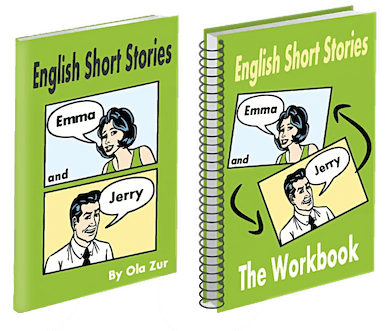
Download your FREE GIFT (the first two chapters of
English Short Stories Book and Workbook)
as soon as you join!
By submitting your email, you consent to receiving updates and newsletters from us and to the sharing of your personal data with third parties for the purposes of sending you communications. We will not spam you. You can unsubscribe at any time. For more information, please see our privacy policy.